

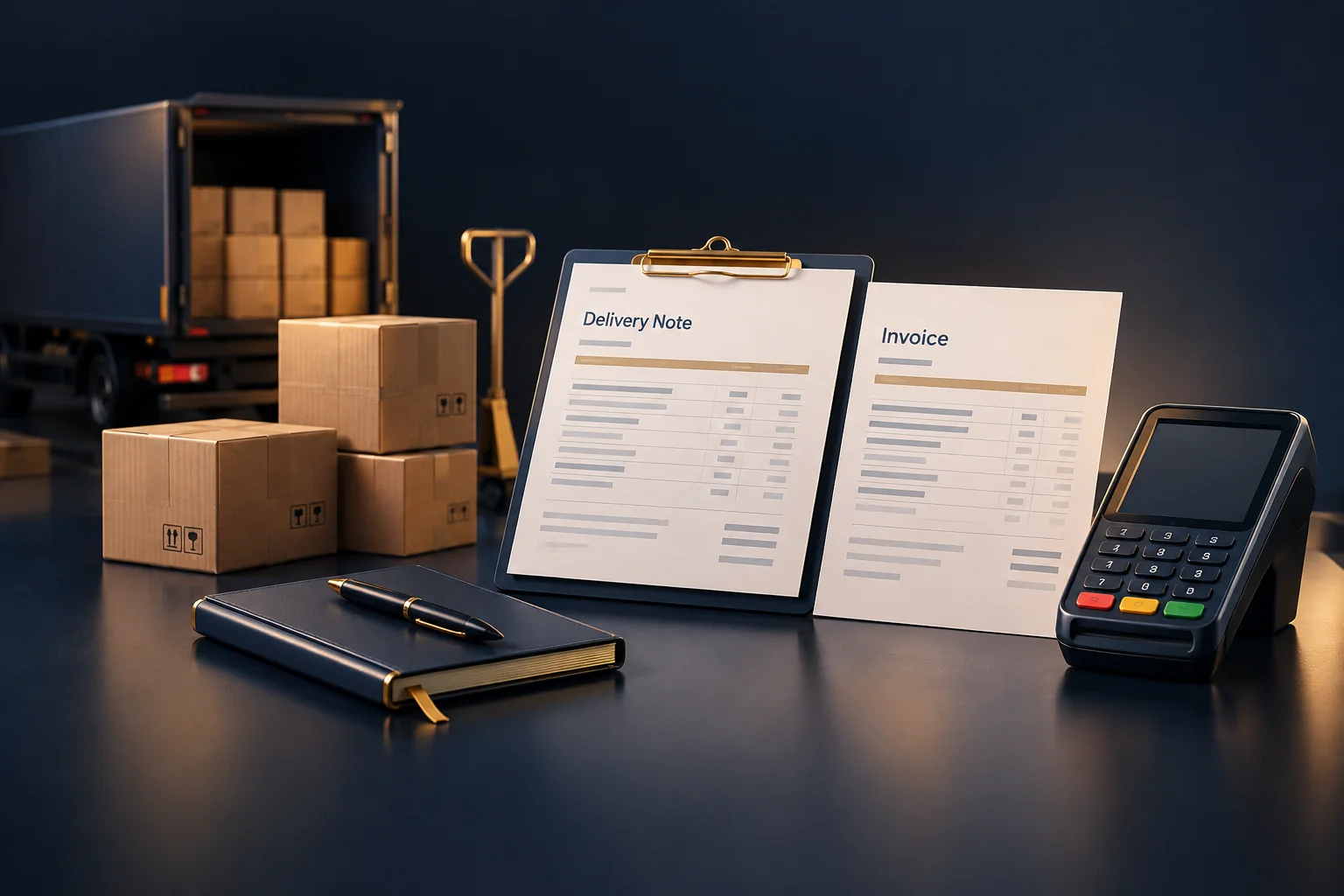
A delivery note supports the goods handover
A delivery note helps your warehouse, driver and customer agree which goods are being handed over. Useful details include the customer and delivery location, delivery date, product descriptions, quantities and a unique delivery reference. Where the customer supplies a purchase order number, carrying that reference through makes their receiving checks easier.
Its operational purpose is to support checking, not to request payment. The receiver should compare the goods with the note and flag missing, damaged or unexpected items. A delivery note alone does not establish that every item was accepted without a problem; keep any discrepancy record alongside it.
An invoice explains the payment request
An invoice tells the customer what you are charging for and provides a reference for their accounts team to use when dealing with that request. For this workflow, the important details are the correct account, the goods being charged for, the amounts, the agreed payment arrangements and references that lead back to the relevant order and delivery records.
Do not expect an invoice to replace the receiving check. An accounts clerk may see the invoice without ever seeing the goods. Equally, the person unloading a delivery may have no responsibility for payments. Ask the customer where each document should go rather than assuming one contact handles everything. This is an operational distinction, not guidance on tax-document requirements.
Choose the document for the task, not just the timing
If the immediate task is checking a drop, provide the delivery note. If it is requesting payment, provide the invoice. Where both tasks happen together, the customer may need both documents. For a trade account with several deliveries, a statement can help review the account position, but individual invoice and delivery references remain important when someone queries a particular charge.
Agree how to handle split deliveries before they happen. Charging for each delivery can make matching straightforward, while grouping deliveries can reduce the number of payment requests the customer handles. Either approach needs clear links and should follow your agreed arrangements. Also decide who records shortages and who reviews their effect on the invoice; do not leave the driver to improvise that decision.
- Ask which references the customer needs to match goods and charges.
- Confirm separate contacts for goods receiving and accounts, where relevant.
- Agree how partial deliveries and discrepancies will be recorded.
Hypothetical example: one order, two deliveries
A café orders 12 cases of drinks from a wholesaler under purchase order CAFE-42. Eight cases arrive on Tuesday with delivery note DN-108; the remaining four arrive on Thursday with DN-115. Each note shows its own delivered quantities and the same customer purchase order reference. The café manager can check each arrival without mistaking the first drop for the complete order.
Suppose the agreed arrangement is to invoice after the full order has been delivered. Invoice INV-260 then covers the 12 cases and references CAFE-42, DN-108 and DN-115. The café’s accounts contact can trace the charge to both deliveries. If Tuesday’s receiver records only seven cases received, the wholesaler should investigate that mismatch before treating the paperwork as settled; the original order quantity is not proof of delivery.
Test whether the references work in practice
Choose one completed order and follow it from dispatch to the payment request. Can someone who did not handle the sale identify what arrived, find any reported discrepancy and understand which deliveries the invoice covers? That is an observable success check. If they need to ask the salesperson what happened, improve the references or handover notes rather than adding more disconnected documents.
NeroTrade supports wholesale workflows including delivery notes, trade accounts, invoices, statements, routes and collections. Confirm which functions are enabled for your merchant account before planning your process around them. Your next action is to review one typical order with your dispatch and accounts colleagues, then agree a shared reference pattern and responsibility for resolving mismatches.
GOOD TO KNOW
Common questions
Does every delivery need an invoice at the same time?
Not necessarily. The customer may need a delivery note at handover and an invoice later under your agreed arrangements. Make the timing clear so neither team mistakes missing paperwork for a missing payment request.
Can one invoice cover several deliveries?
That can be an operational choice where it matches your arrangements. Identify the deliveries clearly so the customer can check each part of the charge without guessing.
What if the delivery note and invoice show different quantities?
Check the order, delivery records and any shortage or return notes. Explain the difference to the customer and resolve the underlying record rather than assuming either document is correct.
Is a statement the same as an invoice?
No. A statement helps review activity and outstanding items on an account. An invoice identifies a particular payment request; keep its reference available when discussing statement entries.