

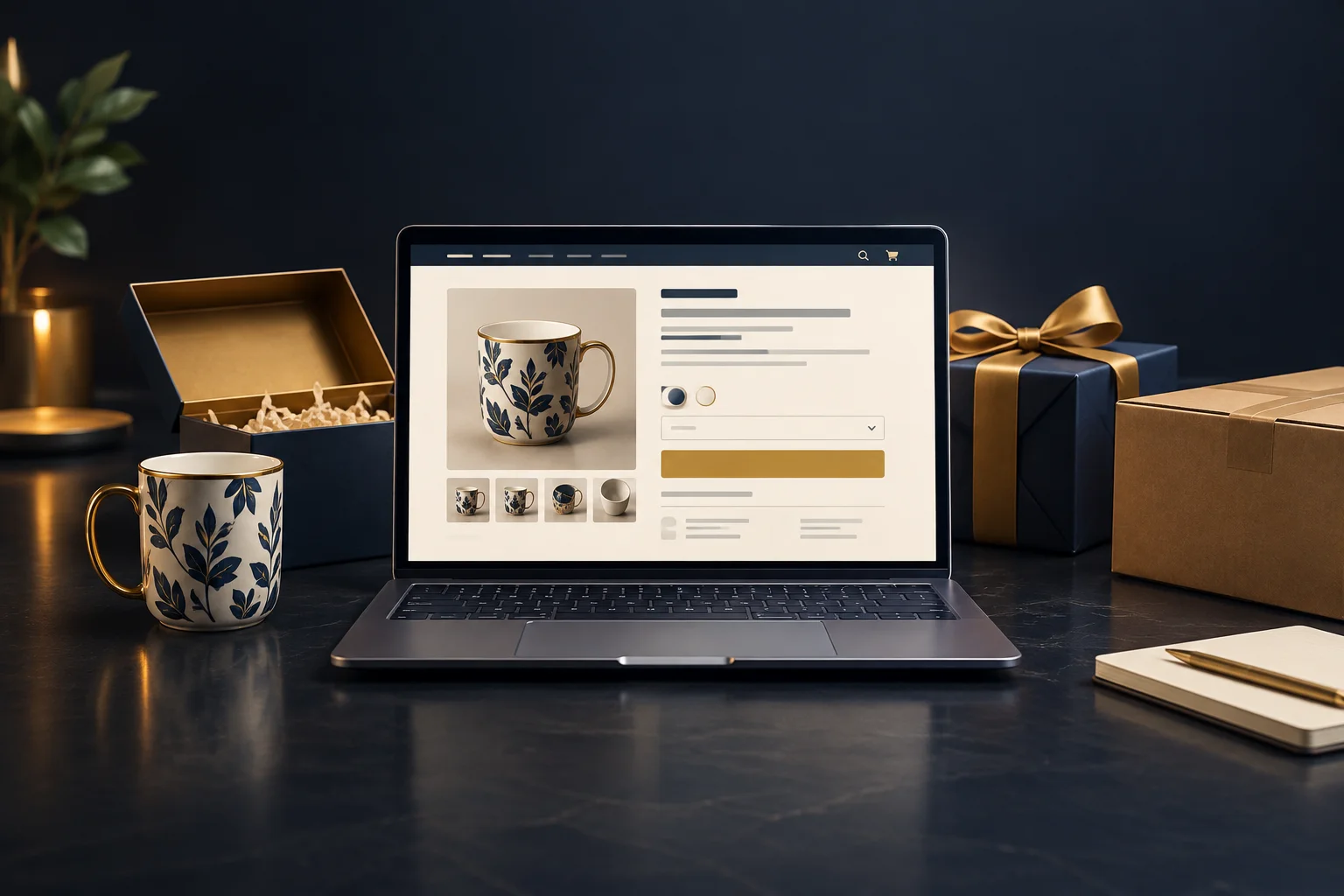
Start with facts that help someone choose
A customer buying a gift cannot pick it up, open the box or ask a member of staff what comes inside. Your description needs to answer those questions. Start with the product type and contents, then give dimensions and relevant materials. Distinguish the size of the item from the size of its packaging: a shelf-sized ornament and a large presentation box create different expectations.
Separate measurable facts from promotional language. “A thoughtful thank-you gift” describes a possible use; “contains one ceramic mug and one cork coaster” describes the purchase. Both can belong on the page, but the promotional line must not replace the contents list. Avoid claims such as “perfect for everyone” or “luxury quality” when a concrete description would be more helpful.
Make photographs and option names agree
Photograph the complete set, the individual pieces and any detail that affects the buying decision. For our gift-shop example, that could mean the mug handle, the coaster surface and the presentation box. A photograph beside a familiar object can suggest scale, but it should support written measurements rather than replace them. State clearly when flowers, wrapping or other props are not included.
Choose option names customers can match to the photographs. “Blue mug” and “Cream mug” are clearer than “Style A” and “Style B”. If only the mug colour changes, say that the coaster and box stay the same. When alternatives have different contents or prices, describe those differences explicitly rather than expecting customers to infer them from an image.
Before and after: a gift set with fewer unanswered questions
Hypothetical example — before: “Beautiful boxed gift set. Choose your favourite colour. Ideal for any occasion. Fast delivery available.” This gives the shopper little basis for choosing. They cannot tell how many pieces they will receive, whether the pictured wrapping is supplied or what “fast” means.
Hypothetical example — after: “Boxed mug and coaster gift set. Includes one ceramic mug, 9 cm high and 8 cm across excluding the handle, one cork coaster measuring 10 × 10 cm, and one presentation box. Choose Blue mug or Cream mug; the coaster and box are the same in both options. Photographs show each colour and the complete contents. Ribbon and flowers are display props and are not included.”
The revised description still needs the retailer’s confirmed price and fulfilment information. Add those facts only after checking them. This example is not a specification for a real product: the practical lesson is to replace an unanswered question with a verified detail, not to make the description longer for its own sake.
Explain collection and delivery before the commitment
A gift may be needed for a particular day, so distinguish preparation time from delivery time. Explain the available fulfilment choices, any relevant restrictions and where customers can see applicable charges. Avoid “ready today” or an arrival promise unless your actual process supports it. For collection, make the location, opening arrangements and readiness instructions easy to find.
NeroWeb provides online storefronts, product catalogues and checkout, with merchant setup supporting collection and delivery settings. Treat the page wording and those settings as one customer journey: they should not contradict each other. Confirm availability and applicable terms with the team rather than assuming a particular fulfilment arrangement is supported.
Check the page as a first-time gift buyer
Ask someone unfamiliar with the item to review the page on a phone. Give them a specific task: choose the cream version as a birthday present and explain what will arrive. This tests understanding more effectively than asking whether the page looks attractive.
An observable success check is that the reviewer can identify the contents, dimensions, selected colour, price and fulfilment expectations without asking you to fill in missing information. Your next action is to review one existing gift-shop page, record every unanswered question and verify the facts before changing its copy.
- Compare the description and photographs with the physical item.
- Check that each option name identifies the intended version.
- Follow the journey towards checkout and compare fulfilment information.
- Correct any mismatch before directing customers to the page.
GOOD TO KNOW
Common questions
How much detail should a product description include?
Include enough to support the buying decision: contents, dimensions, relevant materials, options and exclusions. Put the essentials first, then add useful supporting detail without repeating it.
Can photographs replace written measurements?
No. Angles and styling can distort perceived size. Provide measurements in writing and explain whether they refer to the product or its packaging.
What if a product detail is not confirmed?
Check the item or confirm it with your supplier before making the claim. Do not guess at materials, care instructions, availability or delivery timing.
Should collection information appear only at checkout?
Explain the relevant choices before customers commit, with fuller details available where needed. Ensure the product page and checkout communicate consistent expectations.