

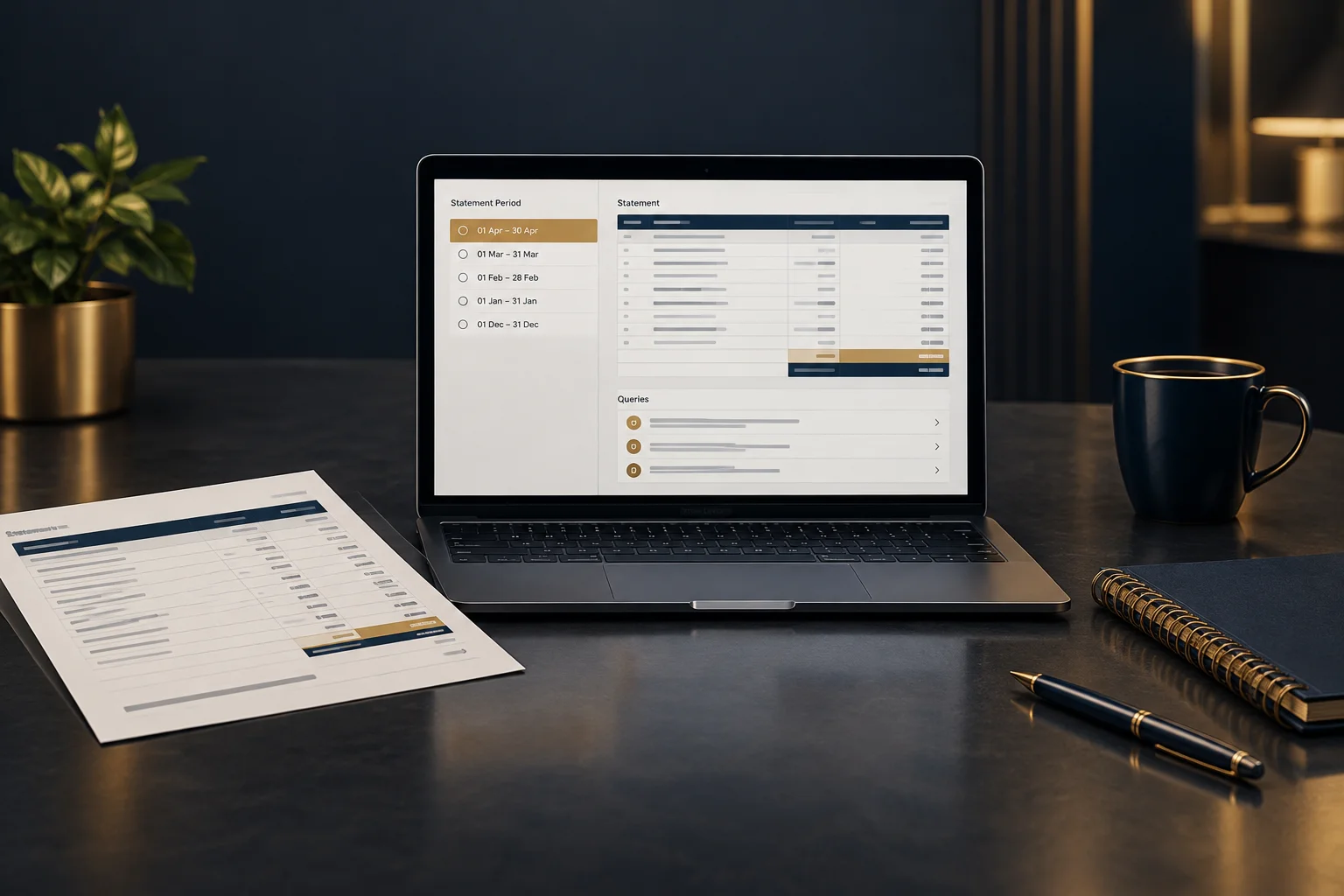
Set the period before discussing the balance
Start with the customer’s correct trade account and a clearly stated date range. Explain whether the statement shows activity during that period or all open items at the cut-off date. These views answer different questions: a period view helps someone review recent activity, while an open-item view helps them identify what remains outstanding.
Check how any opening balance relates to earlier records. If a customer has several branches or buying accounts, make clear which account the statement covers rather than assuming their accounts team will recognise it. A statement prepared to 30 April will not necessarily reflect a payment recorded on 1 May; explain that timing difference rather than treating it as a disagreement.
- Confirm the account name and account reference.
- State the period, cut-off date and type of statement.
- Check the opening balance against the preceding records.
Use references that help the customer find evidence
For each invoice, use its recorded number and date consistently. Where relevant and available, include the customer’s purchase order reference or a related delivery note reference. Do not substitute one document for another: a delivery note helps trace a delivery, while an invoice records the charge. The customer may need both to investigate a query.
Check recorded payments against the information available to you. If a customer says they have paid but you cannot yet match the payment, ask for the payment date, amount and reference through your usual business contact route. Describe it as awaiting matching, not as a confirmed adjustment. Avoid asking for unnecessary banking information.
Separate the statement from the questions
Keep the statement faithful to the underlying account records. Put unresolved matters in a separate query list or covering message, using the same references. For example, distinguish an invoice the customer is questioning from an adjustment that has actually been recorded. Otherwise, a helpful-looking revised total can be mistaken for an agreed account balance.
This separation also makes the conversation more useful. Instead of asking the customer to explain an entire balance, ask one answerable question per item: which delivery is being queried, which payment reference was used, or which document is missing? Give each question an internal owner, and agree when the customer should expect an update without promising an outcome before the checks are complete.
- List the reference and the question beside it.
- State what is confirmed and what still needs checking.
- Record who will investigate and the next contact date.
Hypothetical example: replace a vague total with a clear discussion
Before: a supplier emails a customer, “Your April balance is £1,240. Please arrange payment.” The customer replies that they have already paid £400 and that one delivery was short. Neither message identifies the relevant invoice, payment date or delivery note, so the discussion stalls.
After: the supplier sends the statement for account T104, covering 1–30 April, and writes: “The recorded closing balance at 30 April is £1,240. You have told us about a £400 payment made on 1 May; please confirm its reference so we can match it. Your quantity query concerns invoice INV-218 and delivery note DN-206. We are checking that separately; no adjustment has yet been recorded.”
The covering message then names the supplier’s contact and proposes an update date. It does not present £840 as an agreed balance merely because the customer reported a payment. Success is observable: the customer can identify the exact documents, supply the missing reference and understand which issue is still under review.
Check the handover, then send a focused next action
Before sending, ask a colleague to follow one invoice from the statement to its supporting records. Can they identify the account, understand the cut-off and find the associated query without asking you to explain it? If not, improve the references or covering message. Send the statement to the appropriate customer contact using your usual agreed channel.
NeroTrade supports wholesale workflows including delivery notes, trade accounts, invoices, statements, routes and collections. Confirm which functions are enabled for your merchant account before deciding how to prepare or retrieve records. Whichever workflow you use, your next action is the same: review one customer statement, resolve unclear references and ask only for the information needed to move each open question forward.
GOOD TO KNOW
Common questions
Should a disputed invoice disappear from the statement?
Do not remove it simply to make the discussion easier. Keep the statement consistent with recorded entries and explain the dispute separately. Reflect any adjustment once it has been checked and recorded.
What if a payment arrived after the cut-off?
Explain that the statement reflects records at its cut-off date. Once the later payment is confirmed and matched, provide an updated position where needed, clearly distinguishing it from the original statement.
Should I attach every delivery note?
Not necessarily. Start with clear references and provide supporting documents where they help answer a specific question. Check that attachments relate to the correct customer account before sending.